|
 Toggle Nav


Sentencing in Hong Kong - Twelfth Edition
Authors: I Grenville Cross GBS, SC, Patrick WS Cheung
The 12th edition of Sentencing in Hong Kong is indispensable for judicial officers, practitioners and academics.
It charts the evolution of sentencing law and practice with cogency and precision.
The Appendix summarises useful judgments in all areas and indicates maximum penalties.
Aggravating factors are reviewed, including the theft of mobile phones, domestic violence and pickpocketing.
Mitigating factors are explained, including advanced age, change of penalty and ignorance of the law.
The latest sentencing guidelines for trafficking in dangerous drugs are incorporated, and the ability of previously sentenced offenders to take advantage of them is considered.
The way in which those convicted of national security offences should be sentenced is explained, together with their eligibility for remission.
Latest judgments concerning assistance to the authorities, concurrent and consecutive sentences, costs in criminal cases compensation orders, fines, life imprisonment and the manufacture of dangerous drugs are referenced.
A comparative dimension is provided where considered helpful, and English authority on the factors affecting the discount for those who help the police is included.
This edition is comprehensive and provides insights into aspects of sentencing which will benefit everybody involved in criminal justice.
It is current as of 1 May 2026.
Publication Date: July 2026
Since the publication of the eleventh edition of Sentencing in Hong Kong, some aspects of sentencing law and practice have significantly evolved. Whereas many changes are basically factual and case-specific, others are not and require a proper context. Our mission has always been to analyse, explain and record the effect of sentencing judgments, and indicate the sentencing options available to the courts. After all, sentencing affects not only those directly involved in the criminal justice system but also the wider community, and should be properly understood.
In the Court of Appeal, new sentencing guidelines were issued in 2025 for unlawful trafficking in cocaine, heroin and methamphetamine hydrochloride (“Ice”). This, in turn, generated a detailed consideration of the circumstances in which previously sentenced offenders could take advantage of the situation, even when their applications for leave to appeal were “out of time.” The solution lay in determining if a case was “still in the system.”
Whereas the Hong Kong National Security Law became operational in 2020, the Safeguarding National Security Ordinance was enacted in 2024. Each has generated a not inconsiderable body of case law affecting sentence in various areas. They include collusion with foreign forces to endanger national security, conspiracy to subvert the constitutional order, dealing with an absconder’s assets and seditious activity. The way in which offenders should be sentenced within the NSL’s tiered sentencing bands has also exercised the courts, and the latest sentences for national security crimes of whatever type have been incorporated into this edition.
The Court of Appeal has issued some significant statements of sentencing law and practice since 2024. They address concurrent and consecutive sentencing, costs in criminal cases, generalised sentences, life imprisonment, multiple offences and remission. Apart from including these, we have, where we considered it helpful, borrowed from the jurisprudence of other common law jurisdictions. For example, we have referenced English authority on the factors relevant to determining the discount for offenders who assist the authorities, and also on the duration of compensation order payments.
Perhaps inevitably, the chapters on aggravating and mitigating factors have expanded, with readers advising they have always found the latter of particular assistance. Within aggravating factors, new issues addressed include the theft of mobile phones, the danger of copycat crimes associated with the broadcasting of an offence, domestic violence, pickpocketing by a recidivist, and inciting students to engage in an unauthorised assembly. Mitigating factors include a change of penalty and sentencing guidelines, advanced age and serious crime, delay in prosecuting, ignorance of the law and positive good character.
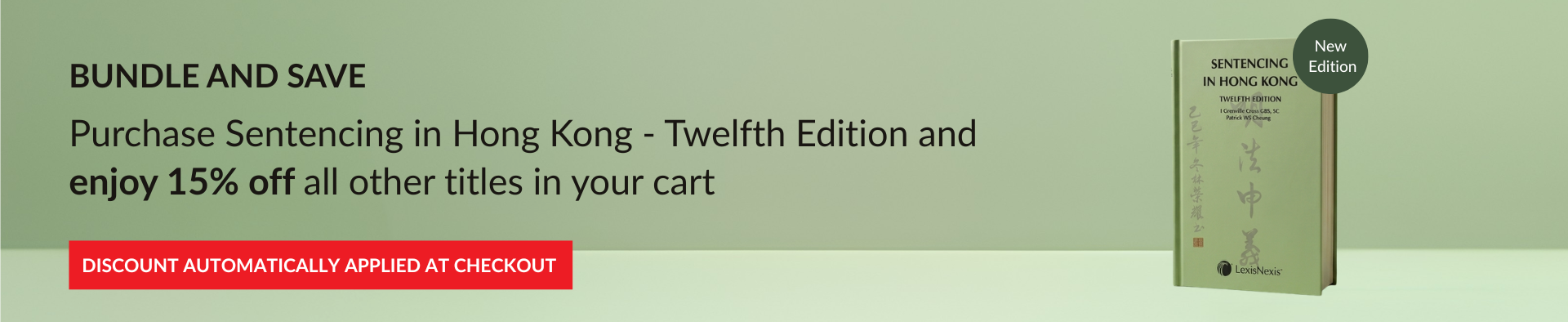
Terms and Conditions:
- The promotion is only available from now to the end of 31 July 2026 (HKT). Any purchases after this period should not be eligible for this promotion.
- This promotion is valid on the LexisNexis Hong Kong e-Store and Lexis Flip™ only.
- This offer cannot be used in conjunction with other LexisNexis discount promotions, student titles and LexisNexis vouchers.
- The discount is not transferable and is not redeemable for cash.
- LexisNexis reserves the right to modify or cancel offer, terms and conditions at any time without prior notice.
- All matters and disputes will be subject to the final decision of LexisNexis.


